

A fully scheduled hydrogen-deuterium exchange mass spectrometry (HDX-MS) system may not be operating at true capacity if low-temperature chromatography imposes a pressure-defined ceiling.
For years, many HDX-MS laboratories had a more visible bottleneck: data analysis. A complex experiment could take days to process and interpret. Software such as HDExaminer™ PRO has substantially reduced that burden, while automation has made sample preparation more consistent and scheduling more efficient.
As those steps improve, the limiting factor can move downstream to the liquid chromatography method itself. This shift is significant because HDX-MS chromatography requires conditions that preserve the deuterium label.
Still, these same conditions increase backpressure, limit flow-rate flexibility, and extend the total LC cycle beyond what the workflow may require. As a result, laboratories have less flexibility in allocating instrument time to productive analysis.
Why low-temperature HDX-MS creates a pressure constraint
After exchange and quenching, digestion and peptide separation are performed under cold, acidic conditions to minimize back-exchange. Lowering the temperature increases mobile-phase viscosity.
At a given column format and flow rate, that higher viscosity produces higher system pressure.[JR1.1] In conventional analytical LC, temperature can sometimes be raised to reduce viscosity and create more operating headroom.
HDX-MS does not offer the same freedom because temperature is part of the strategy used to preserve labeling integrity.
Scientists are therefore balancing three requirements at once: minimize back exchange, maintain adequate chromatographic separation, and remain within the pressure limits of the LC system.
The low temperature is scientifically necessary. The question is whether the analytical column and method are causing the pressure penalty to be larger than necessary.
Where backpressure controls the LC cycle
A common HDX LC method may take approximately 16 minutes, including peptide elution, high-organic-content column cleaning, and re-equilibration.
Not every phase creates the same hydraulic demand. In a water/acetonitrile gradient, the high-aqueous starting conditions and re-equilibration phase typically generate the greatest backpressure.
High-organic cleaning steps generally create less pressure. If a system is already operating close to its pressure limit during the high-aqueous phases, the laboratory has little room to increase flow.
Re-equilibration takes longer; the next sample must wait, and the LC cycle continues to define workflow cadence. Operating with minimal pressure reserve can also increase the risk of leaks or pressure-related interruptions.
Backpressure should be considered a workflow variable rather than only a column specification. It directly affects method duration, scheduling flexibility, and the proportion of instrument time available for productive analysis.
What additional pressure headroom makes possible
A lower-backpressure analytical column does not automatically make every HDX-MS method faster, instead it creates pressure headroom that scientists can choose to apply to selected phases of a LC method.
CHRONECT™ HDX PRO LC Columns are optimized for automated, low-temperature HDX-MS workflows and provide up to 40% lower backpressure. The practical starting point is to compare pressure under the existing method conditions, then use the added pressure drop as an opportunity to, increase flowrates during in all stages of the analytical method, but without exceeding the established operating limit.
As an added aid to maximize method optimisation, As an aid, the CHRONECT HDX Column Calculator is available to support prediction of these operating conditions prior to instrument implementation.
From 16 minutes to 12.5—and, where validated, 10.5
Lets take,as an example a typical 16-minute HDX method comprised of the following steps running at 0.045 ml per min for a 1 mm id column. Typically you may want your back pressure to be below 6000 psi.
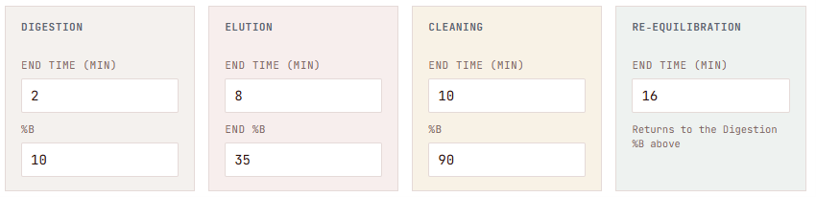
The flow rate during digestion is often fixed because sufficient residence time is required for complete protein digestion; increasing it may therefore result in incomplete digestion.
Fortunately, in this example, digestion accounts for only a small proportion of the total runtime, leaving greater scope to optimise the other three steps.
Even if the elution time remains at eight minutes to allow adequate data acquisition, increasing the flow rates during cleaning and re-equilibration can reduce each run by 3.5 minutes.
Optimising the elution flow rate as well could shorten the method further, reducing the total runtime to 10.5 minutes.
| Illustrative method state | LC runtime | Interpretation |
|---|---|---|
| Common starting method | 16.0 min | Reference cycle under low temperature conditions |
| Cleanup and re-equilibration compressed | ≈12.5 min | ≈22% shorter; original elution segment retained |
| Faster elution, where validated | ≈10.5 min | ≈34% shorter; requires compatible separation and MS acquisition |
Illustrative, method-specific timings.
The impact of these changes means that a typical 60 sample HDX method could be reduce from 16 hours to 10.5 hours. This offers the following benefits.
-
An increase in sample repeats to improve data quality
-
Better utilisation of the HDX robot to process more HDX projects and deliver data quicker, reduce operating costs and all for faster project completion and so increased publication cadence.
It must be highlight that method optimisation is also dependent on, sample delivery, CHRONOS scheduling, chromatographic performance, and mass spectrometer acquisition settings.
The distinction is important: a shorter LC cycle creates the potential for higher throughput, but it does not guarantee a specific number of additional samples.
The CHRONECT workstation must be able to supply samples at the new cadence, CHRONOS scheduling must use the recovered time, and the mass spectrometer must still acquire data of the required quality.
The objective is not speed at any cost. It is to remove unnecessary pressure constraints so that the method can be optimized around scientific requirements rather than hydraulic limitations.
Optimize the workflow—not only the column
Pressure headroom is most valuable when it is coordinated with the rest of the HDX-MS workflow. CHRONOS can align exchange, quench, injection, valve switching, and instrument availability, while the automation platform executes the laboratory’s chosen method.
HDExaminer PRO then reduces the downstream analysis burden. This is not a single proprietary HDX-MS protocol imposed on every laboratory.
CHRONECT provides a configurable environment for automation, scheduling, chromatography, and analysis. Scientists retain control over:
-
Exchange conditions
-
Time points
-
Gradients
-
Flow rates
-
Acquisition settings
-
And acceptance criteria for their application
Before concluding that an HDX-MS system has reached capacity, it is worth asking:
-
Which LC phases are operating closest to the pressure ceiling?
-
How much pressure reserve remains under the highest-aqueous conditions?
-
Could cleanup and re-equilibration be shortened without changing peptide elution? If elution is compressed, will separation and MS sampling remain fit for purpose?
-
Can automation and CHRONOS scheduling convert the recovered minutes into usable capacity?
Conclusion: Start by finding the pressure ceiling
A full instrument schedule does not necessarily mean the workflow is fully optimized. If low-temperature chromatography is forcing longer starting, cleaning, or re-equilibration phases, the laboratory may be reaching a pressure-defined ceiling before it reaches the true capacity of its automation and mass spectrometer.
The more useful question is therefore not simply, “How fast is our HDX-MS method?” It is, “Which parts of the method are longer because pressure—not data quality—sets the limit?” By integrating lower-backpressure HDX PRO LC Columns with configurable automation, CHRONOS scheduling, and HDExaminer PRO analysis,
CHRONECT enables laboratories to assess pressure constraints across the entire workflow and optimize processes based on scientific priorities.
Technical Sources
-
Peterle D, DePice D, Wales TE, Engen JR. Increase the flow rate and improve hydrogen deuterium exchange mass spectrometry. Journal of Chromatography A. 2023;1689:463742. DOI
-
Masson GR et al. Recommendations for performing, interpreting and reporting hydrogen deuterium exchange mass spectrometry (HDX-MS) experiments. Nature Methods. 2019;16:595–602. DOI
-
Anderson KW, Hudgens JW. Chromatography at −30 °C for Reduced Back-Exchange, Reduced Carryover, and Improved Dynamic Range for HDX-MS. Journal of the American Society for Mass Spectrometry. 2022;33. DOI